Custom solutions for demanding applications


Custom solutions for demanding applications
Our Address
Tridelta Siperm GmbH
Ostkirchstr. 177
44287 Dortmund, Germany
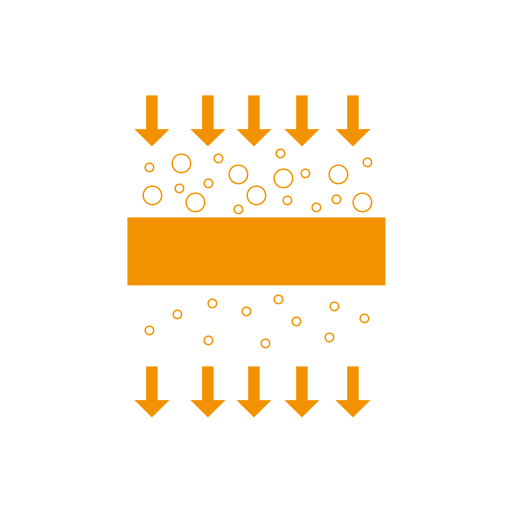
Ventilation describes the controlled exchange of gases between a system and its environment. The aim is to compensate for pressure differences, to discharge or supply gases in a targeted manner and to ensure the safe operation of systems, housings or fluid-carrying systems.
In industrial environments, ventilation is often implemented as a passive function. Porous materials take on the task of enabling the uniform passage of gas without using moving components or active control mechanisms. In contrast to filtration, the focus is not on the separation of particles, but on the defined gas permeability of the porous material.
Aeration elements are used in a variety of technical applications, including for:
Prevention of overpressure or underpressure in closed systems
Discharge of process or reaction gases
Ventilation of enclosures and assemblies
Stabilization of operating states
Relief of systems during temperature fluctuations
A uniform, reproducible gas flow is crucial in order to avoid pressure peaks, noise generation or mechanical stress.
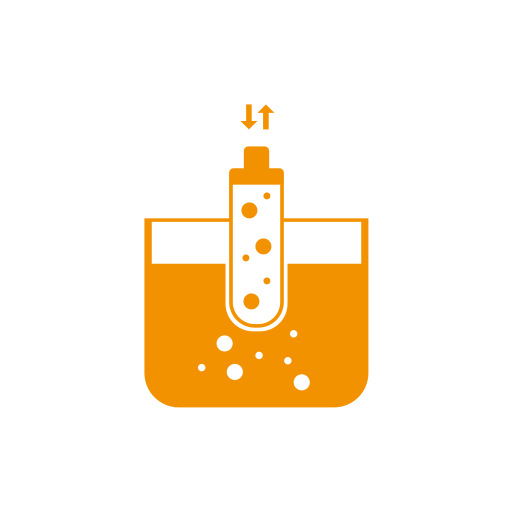
In certain applications, gases must be removed from liquid-carrying systems or housings ventilated without liquid escaping through the ventilation element at the same time. Porous materials that are hydrophobic by nature are used for these tasks.
The hydrophobic properties prevent liquids from penetrating the pore structure, while gases can pass through the porous material. This allows gas bubbles to be evacuated from fluids or pressure equalization functions to be implemented without leakage or moisture ingress.
Medical technology applications for venting fluid systems
Ventilation and pressure equalization of electrical and electronic systems
The selection of the appropriate SIPERM® material depends on the functional requirements of the ventilation as well as the ambient and temperature conditions.
Porous polyethylene is suitable for aeration applications where gas passage is required without liquid transport. SIPERM® HP is hydrophobic by nature and enables reliable separation of the gas and liquid phases in applications up to around 70 °C. The material is the preferred choice when moisture or condensate must be reliably retained.
Porous materials made of stainless steel or bronze are used for aeration tasks when temperature resistance, mechanical stability or chemical resistance are the main requirements. These materials are not hydrophobic and are therefore not used for the targeted separation of gas and liquid. Their use is limited to aeration and pressure equalization functions for gaseous media.
We are happy to advise you – simply contact us by phone, via email or by using our contact form.
Tridelta Siperm GmbH
Ostkirchstr. 177
44287 Dortmund, Germany


 Menu
Menu Call
Call
