

Custom solutions for demanding applications
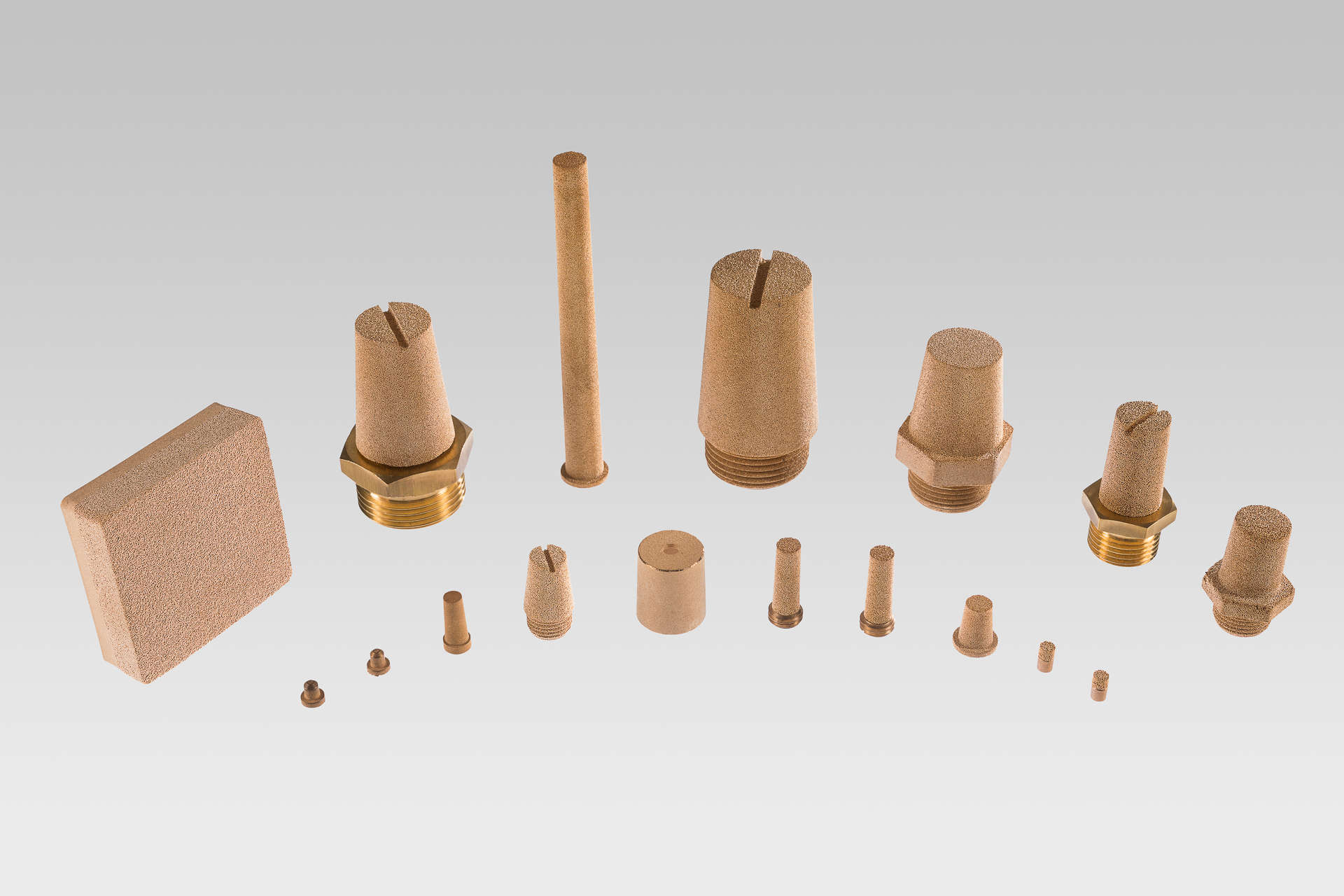
Siperm® B
Our Address
Tridelta Siperm GmbH
Ostkirchstr. 177
44287 Dortmund, Germany
Contact us for a personal consultation
Bronze CuSn 10
Temperature resistance
200°C oxidizing atmosphere
350°C reducing atmosphere
For more information and technical data, please refer to the PDFs available above
Plates
Size: 250 x 500, 500 x 500, 750 x 450, 800 x 300, 1000 x 300, 1000 x 450 mm, seamless
Thickness: 2 - 10 mm
Other formats (welded constructions and cut to size) on request
Sheets made of SIPERM® B consist of porous sintered bronze (CuSn10). The material has an open pore structure with defined permeability and combines this with the good thermal conductivity and toughness of the copper-tin alloy.
The plates are suitable for applications with flow guidance, gas distribution or pressure stabilization at moderate temperatures. Their metallic structure makes them easy to machine, provided the porous functional surfaces are not modified by cutting. Bronze remains dimensionally stable, exhibits ductile behavior and allows precise geometric adjustment. Typical areas of application are distribution surfaces, damping elements or functional plates in systems where thermal conductivity and moderate weight are an advantage.
Tubes
Seamless and welded construction - dimensions on request
Tubes made of SIPERM® B enable a defined radial or axial flow with increased thermal conductivity compared to stainless steel. The bronze structure is less brittle and enables ductile behavior under load.
SIPERM® B pipes are suitable for applications with lower temperatures than SIPERM® R, but offer good chemical and thermal stability for numerous industrial processes. The mechanical properties allow use with moderate pressure differences. The connection is usually made using metallic joining techniques or mechanical clamping constructions.
Circular blanks and molded parts
We have a large range of tools available for the production of circular blanks and molded parts of various sizes. We will be happy to inform you about available dimensions and special shapes on request.
Circular blanks and molded parts made of SIPERM® B are produced by pressing and sintering processes in a defined tool geometry. The porosity remains homogeneous over the entire cross-section. Due to the ductile bronze alloy, more complex molded parts can also be produced that perform both fluidic and mechanical functions.
Typical applications include flow distribution modules, protective caps, functional bodies or inserts in systems where heat dissipation and defined permeability need to be combined. The components retain their shape even under moderate mechanical loads and can be combined with solid bronze components.
Fluidizing units
Fluidizing floors according to customer requirements
SIPERM® B is suitable for fluidization tasks where temperature loads remain moderate and good thermal conductivity is required at the same time. The pore structure enables homogeneous gas distribution, which reliably loosens up fine-grained powders.
The bronze alloy allows stable operation even with changing flow parameters. Typical applications include the fluidization of less abrasive powders or use in applications where stainless steel would be oversized but bronze is preferred due to its properties.
Filter cartridges
Seamless and welded construction - dimensions on request
Filter cartridges made of SIPERM® B are manufactured from porous bronze semi-finished products. They are suitable for filtration tasks at low to medium temperatures and pressure differences. The pore sizes of the bronze grades enable defined particle separation, while the thermal conductivity of the bronze distributes thermal loads well.
The candles can be cleaned, in particular using countercurrent or suitable solvents. They are suitable for liquid and gaseous media as long as they are compatible with bronze. Typical areas of application include gas distribution, pre-filtration, process ventilation or functions in systems where combinations of flow, temperature and heat transfer are relevant.
SIPERM® B
Material basis and positioning
SIPERM® B is a porous sintered material based on the copper-tin alloy CuSn10. It is used in industrial applications that require defined flow, distribution or filter properties and at the same time require good machinability, thermal conductivity and high reproducibility. The material is produced by sintering bronze granules of specific grain fractions. During sintering, the particles bond together metallically, creating a stable structure in which a continuous open pore network is formed.
The structure differs significantly from wire mesh or polymer filters: SIPERM® B has a three-dimensionally distributed pore network that is active across the entire thickness of the material. The porosity is not random, but defined by grain fraction and press density. This results in reproducible permeabilities and pressure loss characteristics. The material selection is particularly suitable for applications in which flow guidance, gas distribution or damping effects are required and moderate mechanical and thermal loads occur at the same time.
Microstructure and characteristics of the pore network
The open pore system of SIPERM® B is created by controlled fusion of the contact points between the bronze granules. The interstices remain as cross-linked cavities. The pores are open and interconnected. This enables a homogeneous flow over the entire surface.
Distribution and size of the pores
The pore size depends directly on the grain fraction. Depending on the selected quality, SIPERM® B covers pore ranges from around 8 to 160 µm. The permeability values and bubble point indices are determined in accordance with the relevant test standards and are used for technical design.
The homogeneity of the structure ensures that pressure losses do not vary locally, but occur evenly across the entire component geometry. This is particularly relevant where defined distribution, venting or flow stabilization are required.
Typical material properties due to the bronze structure
Due to its composition, bronze has specific properties that continue in the porous state:
-
Good thermal conductivity
-
High toughness compared to brittle porous materials
-
Stable pore structures without structural embrittlement
-
High dimensional stability under continuous load
The open pore structure combines the physical properties of CuSn10 with a defined flow functionality.
Flow behavior and functional characteristics
The flow behavior of SIPERM® B – analogous to SIPERM® R – follows an interplay of laminar and turbulent dominated components. The specific coefficients are specified for each material so that pressure loss curves remain calculable.
Laminar flow
Laminar flow predominates at lower volume flows. The pressure loss increases proportionally to the flow rate. This is particularly relevant for applications where a reproducible and low-disturbance flow profile is required.
Turbulent flow
The turbulent component increases in higher flow ranges. The pore channels create deflections, micro turbulence and local pressure reduction zones. As a result, the pressure loss increases disproportionately. The corresponding coefficients are listed in the technical data sheet and are used for design purposes.
Functional effect in the process
SIPERM® B has a fluidic effect:
-
Distribution medium for gases and liquids
-
Calming element that reduces pressure peaks
-
Filter stage with defined particle retention
-
Damping element for flow-induced fluctuations
-
Porous resistor that converts energy into frictional heat
The material therefore performs several functions simultaneously in many processes without the need for additional components.
Mechanical properties and strength behavior
Due to the metallurgical structure of CuSn10, SIPERM® B has a good combination of strength and toughness. Although the material is porous, the sintered structure offers high stability against mechanical loads. The strength is created by the large number of metallic contact points between the particles, which fuse together permanently during sintering.
Compared to other porous materials, such as ceramic sintered bodies or polymer filters, bronze has a lower tendency to brittle fracture. This increases safety in the event of dynamic or locally changing loads. Tensile, bending and shear strengths are defined specifically for each material and form an essential basis for the structural design. The strength decreases moderately with increasing porosity, but remains sufficient for typical technical flow-related applications even in coarser grades.
Bronze also has a higher ductility than stainless steel sintered materials. This means that load peaks or slight plastic deformations can be better absorbed without structural failure of the pore channels occurring. At the same time, dimensional stability is fully maintained at typical operating temperatures.
Thermal behavior and temperature resistance
SIPERM® B is thermally resilient and has the high thermal conductivity typical of bronze. This property enables rapid heat distribution within the component, which reduces local temperature peaks. The thermal load capacity remains stable as long as the application is below the alloy temperatures of CuSn10.
The material is suitable for temperatures at which polymer-based or organic filter media can no longer be used. It does not show any structural embrittlement even with continuous heating or thermal cyclization. The pore structure remains stable as the metallic bond in the sintered structure does not degrade or soften thermally.
The good thermal conductivity also has a functional effect: Heat is efficiently dissipated in the event of flow-induced energy input or frictional behavior in the pore system. This is advantageous in applications in which thermal stress is caused by pressure drops or friction.
Chemical resistance and media compatibility
The chemical resistance of SIPERM® B corresponds to the properties of the copper-tin alloy CuSn10. The material is resistant to many industrial media, in particular:
-
numerous alcohols
-
organic solvents
-
neutral and slightly alkaline liquids
-
technical gases
The open pore structure leads to an increased inner surface area, which allows media to come into more intensive contact with the material. This must be taken into account with more aggressive substances. Under normal industrial conditions, the material structure remains stable and shows no tendency to corrode, provided the media are compatible with bronze.
Due to the material composition, SIPERM® B should not be brought into contact with strongly oxidizing acids or media containing chlorine, as this can lead to corrosion. However, the chemical stability is sufficiently high for many standard applications in the field of gas distribution, venting or flow control.
Processing properties and integration into technical systems
SIPERM® B is easy to machine. However, the pore structure requires that processing steps are carried out in such a way that the functional flow surfaces are not closed or compacted.
Mechanical processing
-
Drilling, turning and milling are possible, but should be limited to solid edge areas.
-
Processing the active porous surface leads to pore blockage and must be avoided.
-
Water jet cutting and spark erosion are suitable for precise contours, as these processes do not affect the pore structure.
Reshaping
Bronze has a higher ductility than stainless steel. This means that limited forming processes – such as slight bending or adaptation to housing geometries – are possible, provided the component thickness and pore structure allow this.
Connection technology
SIPERM® B can be joined with solid bronze parts or CuSn10-compatible alloys. Thermal joining processes must be adapted to prevent local overheating or compaction of the pores.
This processability makes it possible to integrate SIPERM® B into complex technical assemblies that combine flow-active areas with solid structural or connecting elements.
Cleaning and maintaining functionality
The porous structure of SIPERM® B has a pronounced inner surface in which media components can be deposited. Cleanability is therefore a key factor for long-term use. The appropriate cleaning method depends on the degree of soiling and the medium used.
Mechanical cleaning
Mechanical counterflow cleaning is sufficient in many cases. A suitable gas or liquid is passed through the material against the operating direction. This loosens loosely bound particles and removes them from the pore system. This process can often be used without removing the component and is suitable for regular maintenance.
Physical cleaning
Ultrasonic cleaning or hot steam processes are suitable for deeper or more adherent deposits. Bronze has good thermal conductivity, which means that thermal cleaning processes can work efficiently without overheating or damaging the material locally. However, this requires complete drying after the cleaning process.
Dry cleaning
Chemical cleaning agents – such as alcohols, acetone or suitable neutral solvents – can be used if deposits cannot be removed mechanically. The exposure time must be carefully limited, as the inner surface of the material is significantly larger than that of solid bronze.
Highly corrosive media, especially oxidizing acids, should not be used as they can attack the bronze alloy.
Overall, SIPERM® B is easy to regenerate. With the right cleaning method, the original permeability can be almost completely restored.
Functional advantages in an industrial environment
SIPERM® B is used in technical processes where defined flow, distribution or retention functions are required under moderate mechanical and thermal loads. The combination of pore structure and bronze microstructure offers several functional advantages.
Homogeneous flow control
The cross-linked pore network ensures an even distribution of the medium over the entire cross-sectional area of the component. This reduces flow gradients and stabilizes processes.
Reproducible pressure loss behavior
The flow characteristics of SIPERM® B are defined and can be taken into account in the design. The pressure loss development remains stable even under changing operating conditions as long as the pore structure is not blocked.
Good thermal properties
The thermal conductivity of the bronze alloy ensures that heat generated by pressure drop or friction is efficiently distributed. This protects components and media from local overheating.
Mechanically stable, yet ductile structure
SIPERM® B is less brittle than many alternative porous materials. The combination of strength and ductility increases operational safety, especially in environments with vibrations or low impact loads.
Long-term usability due to cleanability
The ability to regenerate the pore system using various cleaning processes significantly extends the service life. This means that the material remains reliable over numerous operating cycles.
SIPERM® B Summary
SIPERM® B is a porous bronze sintering material that can be used in a wide range of applications thanks to its defined porosity, reproducible flow characteristics and good thermal and mechanical properties. The open pore network enables the uniform distribution of gases and liquids, the controlled reduction of pressure peaks and the defined retention of particles.
The material structure is stable against mechanical loads and exhibits higher ductility than many metallic or ceramic porous alternatives. The thermal conductivity of the bronze structure supports thermally stressed applications, while the chemical resistance is sufficiently high for SIPERM® B to be used safely in a wide range of technical processes.
SIPERM® B can be flexibly integrated into assemblies thanks to its good machinability and the possibility of integration into metallic constructions. The cleanability ensures long-term use so that the functional parameters are maintained over many operating cycles.
Overall, SIPERM® B is a resistant, functionally versatile material that provides a stable and reproducible basis for flow, distribution and retention functions in technical applications.

 Menu
Menu Call
Call

Contact
We are happy to advise you – simply contact us by phone, via email or by using our contact form.
Service
Tridelta Siperm GmbH
Ostkirchstr. 177
44287 Dortmund, Germany